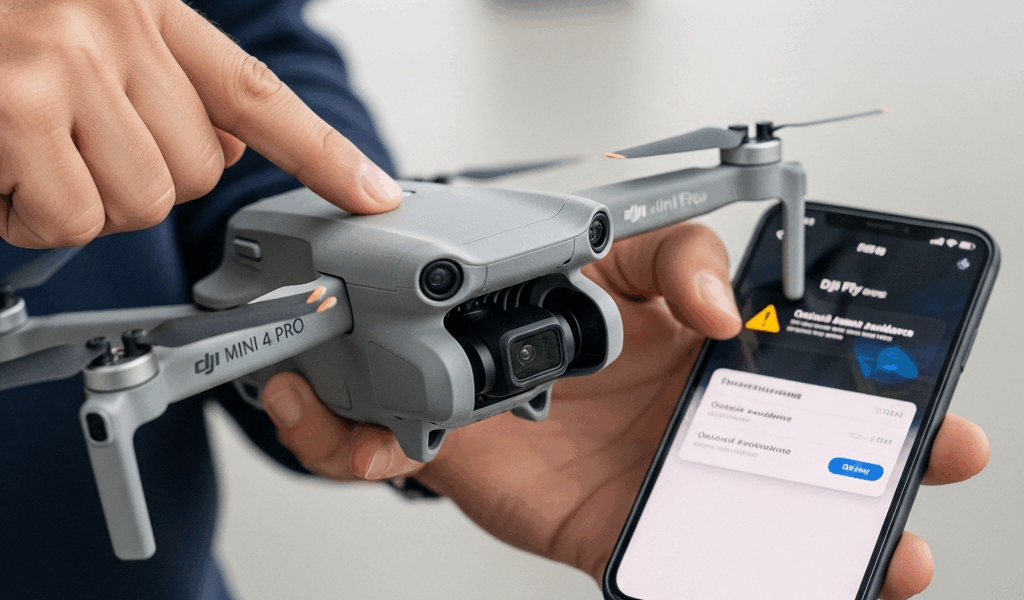
DJI Mini 4 Pro Obstacle Avoidance Not Working — How to Fix It
DJI Mini 4 Pro obstacle avoidance has gotten complicated with all the conflicting advice flying around online. As someone who’s logged serious hours troubleshooting this exact problem across two separate units, I learned everything there is to know about what actually breaks it — and what actually fixes it. The moment that kicked it off for me: standing in an open field, drone climbing toward a tree line, zero warning from the sensors. Nothing. Just a $760 aircraft heading toward pine trees at a casual pace while I jabbed at the controller.
This article includes affiliate links. We may earn a commission at no extra cost to you.
The Mini 4 Pro runs omnidirectional sensing — front, rear, lateral, upward — which is genuinely impressive for something under 250 grams. But it fails quietly sometimes, and the cause isn’t always what you’d expect. I’ve burned probably 40+ hours across forum threads, DJI support tickets, and my own flights narrowing this down. Here’s what works.
Check These Settings First
Probably should have opened with this section, honestly. The majority of cases where obstacle avoidance seems broken are just a settings issue — not a hardware fault, not a firmware bug. Took me an embarrassingly long time to figure this out the first flight it happened.
Visual Navigation Settings Toggle
Open DJI Fly. Connect to the Mini 4 Pro. Tap the three-dot menu icon — top-right corner — to get into Safety settings. Scroll down to Visual Navigation Settings. There’s a master toggle sitting right at the top of that submenu. If that toggle is off, everything is disabled. APAS, braking, all of it. Just gone. No indicator on the main flight screen. No warning. No flashing icon. Nothing.
Tap it on. That’s the fix for a surprisingly large chunk of people reading this right now.
While you’re in that menu, check the behavior setting — options are Bypass, Brake, or Off. Brake stops the drone when something gets too close. Bypass activates APAS 5.0, which tries to route around obstacles on its own. Off kills detection entirely during manual flight. Set it to Brake or Bypass. Don’t leave it on Off and then wonder why nothing triggers.
Flight Mode — The Hidden Culprit
This one catches people constantly. Sport Mode disables obstacle avoidance completely — that’s not a glitch, DJI built it that way intentionally. The Mini 4 Pro tops out around 54 kph in Sport, and the sensor processing genuinely can’t keep pace with reliable obstacle detection at those speeds.
Look at the flight mode indicator on the left side of your DJI Fly screen. If it shows “S,” you’re in Sport. Switch to Normal or Cine — physical switch on the RC-N2 controller, or through the on-screen mode selector on the RC 2. Obstacle avoidance comes back the moment you’re in Normal.
I once flew an entire 20-minute session wondering why nothing was triggering. Landed, glanced at the screen. Big S sitting there the whole time. Sometimes it’s that simple and that frustrating. Don’t make my mistake.
Tripod Mode and ActiveTrack Behavior
Tripod Mode keeps obstacle avoidance active — but sensitivity thresholds drop because the drone is moving slowly enough that braking distances are short. That’s fine. The behavior that surprises people: certain QuickShot modes like Dronie or Circle suspend APAS Bypass temporarily. The drone follows its programmed flight path. Brake still works, so it’ll stop if something gets critically close — but it won’t reroute around anything. Worth knowing before you run a Circle shot near trees.
Firmware Update Fix
Firmware is the second thing to check — settings come first, always. But real, documented obstacle avoidance malfunctions have traced back to specific firmware builds on the Mini 4 Pro, and the fix is straightforward once you know what to look for.
How to Check Your Current Firmware
In DJI Fly, tap the three-dot menu, hit About, check the firmware version listed under your aircraft. The stable build as of mid-2024 is 01.00.0500 or later. Builds in the 01.00.02xx range had documented problems — false positive brake events where sensors triggered with nothing nearby, and cases where sensors stopped reporting entirely after a hard landing.
Frustrated by repeated false braking mid-flight, I updated expecting to lose something and instead just got stability back. The 01.00.0500 build specifically fixed vision sensor communication errors that showed up inconsistently in cold weather — roughly below 10°C / 50°F. If you fly in winter, this one matters.
Updating via DJI Fly App
Connect drone and controller to DJI Fly. A blue banner appears at the top of the main camera screen if an update is waiting — “New firmware available.” Tap it, follow the prompts. Takes about 8 to 12 minutes depending on your connection. Transfers over the RC link — no USB cable needed for OTA.
Battery needs to be above 50% before you start. DJI Fly won’t initiate the update below that threshold, which is smart — a failed mid-update power loss can brick the aircraft. A replacement Main Controller board through DJI’s repair service runs around $140 USD. Not worth the risk over a battery percentage.
Updating via DJI Assistant 2
If the in-app update fails or hangs partway through, go to DJI Assistant 2 (Consumer Drones Series) on Windows or Mac. Connect the Mini 4 Pro via USB-C to the aircraft’s charging port. Open Assistant 2, log into your DJI account, select your aircraft, go to Firmware Update. You can also force-install a specific version here — useful if you want to roll back and confirm whether a recent update introduced the problem you’re seeing.
Sensor Calibration
Calibration is where people skip steps, get partial results, and then assume nothing is working. There are two levels — the automatic self-calibration the drone handles on its own, and the manual process through DJI Assistant 2.
Automatic Self-Calibration After Takeoff
The Mini 4 Pro’s vision and infrared sensors self-calibrate during the first one to three minutes of each flight — runs in the background, no input required. For it to complete properly, fly low — between 2 and 6 meters — over a surface with visual texture. Grass, gravel, pavement, anything with contrast and pattern. Smooth concrete, still water, packed snow — these interfere with the visual odometry and can leave calibration incomplete for the rest of the flight.
Hover for 30 to 60 seconds, then run a slow wide circle. Cold boot in an open area — not inside, not near buildings — and keep it away from strong radio interference during this window. It’s a small habit that prevents a lot of inconsistent behavior later.
Manual Calibration via DJI Assistant 2
If obstacle avoidance feels sluggish, triggers inconsistently, or “Vision System Error” keeps appearing and clearing and appearing again — run a manual calibration. Connect the Mini 4 Pro to DJI Assistant 2 via USB-C. Go to Tools > Sensor Calibration. Run the Vision Sensor calibration specifically — it walks through a series of positioning steps, tilting and rotating the drone on-screen. Takes about 4 minutes total.
Do this on a stable surface, away from vibrations, battery fully charged. I run it after any landing where the drone hit ground harder than a gentle settle. Shock can shift sensor alignment — even slightly — and a small offset affects detection range accuracy in ways that show up as weird inconsistency rather than a clean error message.
Environmental Causes
But what is a sensor limitation? In essence, it’s a condition where the hardware works exactly as designed but the environment sits outside what the system can handle. But it’s much more than a simple caveat — understanding it changes how you fly.
Low Light Conditions
The Mini 4 Pro’s visual sensor array depends on ambient light. Dawn, dusk, heavy overcast, indoor environments — light drops below usable thresholds and DJI Fly shows “Visual Navigation Unavailable.” At that point, obstacle detection falls back to infrared sensors for close-range braking — roughly 0.5 to 8 meters — but APAS bypass stops. No rerouting. Just braking at close range.
This is expected. Fly conservatively in low light. Obstacle avoidance is not a substitute for situational awareness — that’s true in perfect conditions and doubly true when the sensors are already operating degraded.
Smooth, Featureless, or Reflective Surfaces
Flying over water, snow, or glass surfaces knocks out downward visual positioning — and can throw off horizontal sensors too. Reflective surfaces scatter infrared signals in unpredictable directions. The drone may miss an obstacle reflected in a glass building. It may also false-trigger on its own reflection over still water. Direct sunlight aimed straight into a forward-facing sensor causes temporary blindness in that axis — most common during low-angle morning or afternoon sun. Rotate your flight path so you’re not heading directly toward the sun at low altitude.
Rain, Fog, and Condensation
The Mini 4 Pro has zero water resistance rating. Water droplets on sensor lenses cause visual processing errors that kill obstacle detection — even light mist can coat the sensor glass within a few minutes. Wipe lenses before every flight with a microfiber cloth — the kind used for camera lenses, not paper towels. Paper towels leave micro-scratches on optical surfaces over time. A LensPen MiniPro for Drones is sized specifically for small drone optics and keeps sensor glass clean without leaving residue. Small thing, real consequence.
Hardware Issues — When to Contact DJI
If you’ve worked through every section above and obstacle avoidance still isn’t functioning, the problem may be physical. That’s what makes this system endearing to us drone pilots — it’s genuinely robust software-side, which means when it still doesn’t work after all the software fixes, the hardware answer is usually clear.
Vision System Error Messages
A persistent “Vision System Error” or “Obstacle Avoidance Sensor Error” that doesn’t clear after calibration and firmware update points to a hardware fault. This shows up in the safety notifications panel inside DJI Fly. Screenshot it. Note whether it appears at boot or only after flight time — that timing detail matters for DJI’s diagnostic process.
Physical Sensor Damage and Debris
Inspect every sensor window. The Mini 4 Pro has sensor clusters on the front — two lenses — rear — two lenses — left side, right side, top infrared, and bottom. Look for cracks, deep scratches, clouding. Even hairline cracks cause sensor malfunctions that don’t read as obvious damage in a casual glance. Use a flashlight and look at an angle.
Check for debris too — dried mud, dust, plant material packed into sensor housing gaps. A can of Falcon Dust-Off compressed air used from roughly 4 to 6 inches away clears surface debris without risk — just don’t blast directly into electronics openings. No solvents on sensor lenses. Dry microfiber only, or a lens cleaning pen rated for optical surfaces.
The RMA Process
If damage is confirmed or errors persist after all software-side fixes, submit a repair request through DJI’s support portal at support.dji.com. Select your aircraft model, describe the issue, attach flight logs — DJI Fly stores them locally under the “Me” tab, then “Flight Records.” These logs are critical. They can determine whether a repair falls under warranty or not.
DJI Care Refresh for the Mini 4 Pro — purchased within 48 hours of activation — covers sensor replacements. Without Care Refresh, a full forward vision sensor replacement through DJI’s service center typically runs between $80 and $120 USD depending on labor and parts availability in your region.
DJI Care Refresh might be the best option, as sensor repair requires tight alignment tolerances. That is because a DIY replacement — even with new hardware — almost always results in continued degraded performance. The tolerances are tight enough that getting it wrong means you’ve spent money on parts and still have a malfunctioning obstacle avoidance system. Get it to DJI. This one isn’t worth attempting yourself.



Stay in the loop
Get the latest light drones updates delivered to your inbox.