
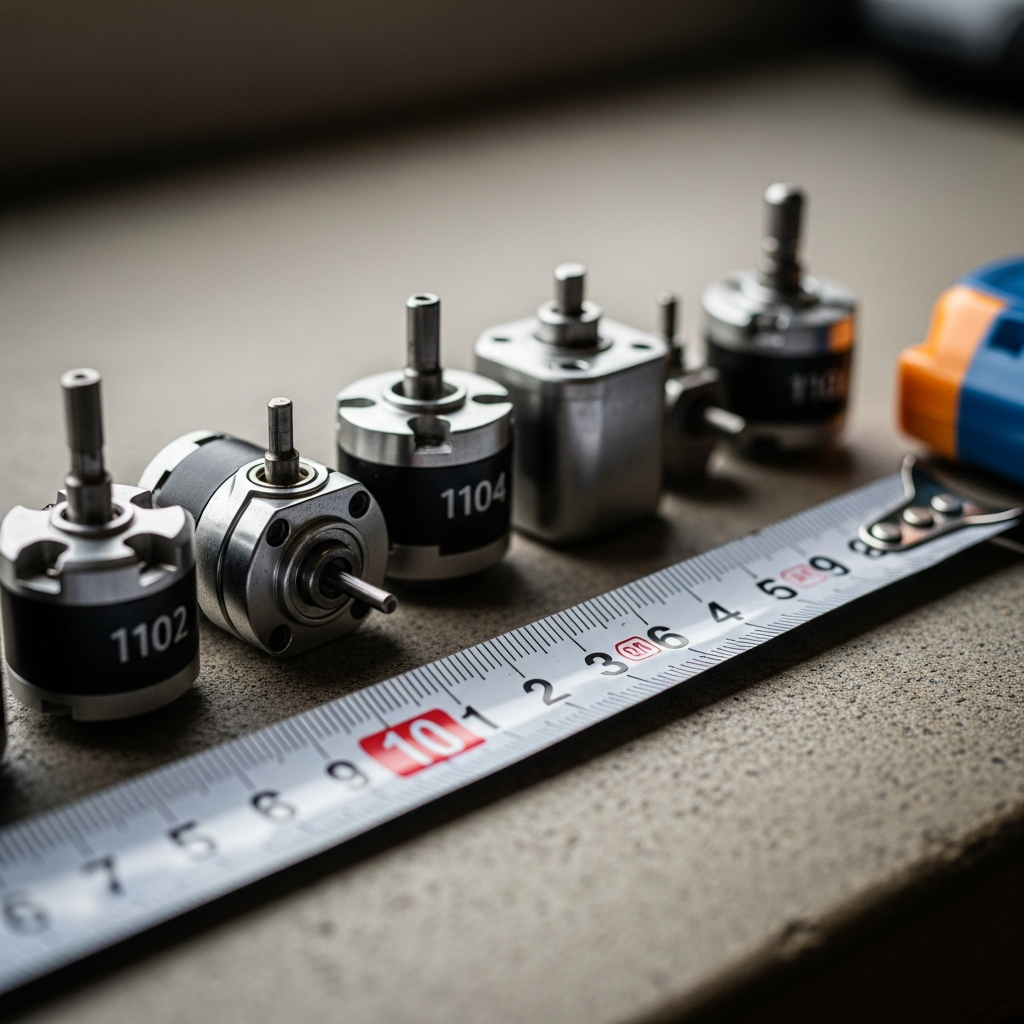
The motors spinning your micro drone’s propellers determine everything about flight performance. Understanding motor sizing—those cryptic numbers like 1102, 1103, and 1104—helps you choose components that match your build goals.
Decoding Motor Size Numbers
Motor size designations describe physical dimensions in a standardized format. The first two digits indicate stator diameter in millimeters. The last two digits specify stator height in millimeters. An 1103 motor has an 11mm diameter stator standing 3mm tall.
Stator dimensions directly determine motor characteristics. Wider stators produce more torque. Taller stators generate more power and speed. These trade-offs define how each motor size performs across different applications.
1102 Motors: The Tiny Powerhouses
1102 motors measure 11mm diameter with 2mm stator height—among the smallest brushless motors in common use. These tiny powerhouses drive Tiny Whoop and micro quad builds weighing 25-40 grams.
The compact dimensions suit 1S and light 2S applications perfectly. Power output matches small propellers in the 31-40mm range. Attempting to spin larger props on 1102 motors creates excessive heat and premature failure.
Weight typically runs 2-3 grams per motor—enabling complete quad builds under 30 grams for the most aggressive ultralight builds. This minimal mass also improves handling response and reduces inertia during direction changes.
Popular 1102 motors include the BetaFPV 1102 series, Happymodel SE0802 variants, and various manufacturer offerings at different KV ratings. Competition in this size class drives continuous improvement in performance and reliability.
1103 Motors: Versatile Performers
Adding 1mm of stator height transforms motor capabilities significantly. 1103 motors offer meaningfully more power and torque than 1102 variants while remaining suitable for micro builds.
These motors excel on 2S power systems driving 2-2.5 inch propellers. The additional stator height provides headroom for more aggressive flying and heavier camera payloads that would overwhelm 1102 motors.
Weight increases to 3-4 grams typically—a minor penalty for substantial performance gains. Complete builds using 1103 motors commonly target 50-80 gram all-up weights, fitting comfortably under 250 gram limits with generous payload margins.
The 1103 size represents perhaps the most versatile micro motor class. Options span wide KV ranges, quality tiers, and price points. New builders often start here for forgiving performance characteristics.
1104 Motors: Micro Power Monsters
1104 motors push micro motor capabilities toward their practical limits. The 4mm stator height delivers substantial power increases over 1103 variants—enough to drive 2.5-3 inch propellers aggressively.
These motors suit 2S and 3S applications with heavier payloads or performance-focused builds. Cinewhoop platforms carrying GoPro-class cameras often specify 1104 motors for adequate thrust margins.
Weight runs 4-6 grams depending on design and materials. The penalty remains modest relative to performance gains, though builders counting individual grams note the increase.
Heat management becomes more critical at this size. Larger stators generate more waste heat under load. Adequate cooling airflow and conservative throttle management extend motor lifespan in hot-running 1104 setups.
Understanding KV Ratings
KV rating describes motor speed per volt of applied power—higher KV means faster spinning at equivalent voltages. This specification interacts with propeller size and battery voltage to determine system performance.
Lower KV motors (6000-12000) spin slower but produce more torque, suiting larger propellers that need force to accelerate. Higher KV motors (15000-25000+) spin faster but with less torque, matching smaller props on higher voltage systems.
Matching KV to propeller and voltage creates efficient systems. Mismatched combinations either lack power (KV too low for props) or overheat motors (props too large for KV). Manufacturer recommendations provide good starting points.
Bearing Quality Matters
Motor bearings determine longevity and vibration characteristics. Quality bearings spin smoothly for thousands of flights. Cheap bearings develop play and roughness within dozens of flights, introducing vibrations that degrade video quality and stress other components.
Premium motors typically use Japanese-made bearings from NSK, NMB, or equivalent manufacturers. Budget motors often substitute Chinese bearings of variable quality. The price difference between premium and budget bearings within a motor runs perhaps $0.50-1.00—yet bearing quality affects motor lifespan dramatically.
Crashed motors often survive externally while suffering internal bearing damage. Motors that suddenly vibrate, make unusual sounds, or resist rotation likely need replacement regardless of external appearance.
Magnet Materials and Grades
Rotor magnets vary in strength and temperature tolerance. N52 grade neodymium magnets provide strongest fields but demagnetize at lower temperatures than N45 or N48 grades. Hot-running motors may benefit from slightly lower magnet grades that maintain field strength under thermal stress.
Magnet count affects motor smoothness and efficiency. More magnets create smoother rotation with reduced cogging but add weight and cost. Micro motors typically use 8-12 magnet configurations balancing these trade-offs.
Bell Design and Weight
Motor bells (the rotating outer housing) vary in construction and weight. Lighter bells improve motor response and reduce total weight. Stronger bells survive crashes that would destroy lighter alternatives.
CNC-machined aluminum bells offer precision and durability at reasonable weight. Stamped steel bells add grams but cost less to manufacture. Titanium bells save maximum weight for racing applications willing to pay premium prices.
Bell ventilation affects cooling. Slotted or vented bells allow better airflow to windings, reducing operating temperatures during extended flights. Closed bells run hotter but offer better debris protection in dusty environments.
Wire Gauge and Leads
Motor wire thickness affects power delivery and weight. Thicker wires reduce electrical resistance, enabling cleaner power delivery at cost of added grams. Thinner wires save weight but may limit maximum current flow.
Lead length varies between manufacturers. Longer leads simplify installation but add weight. Many builders trim leads to minimum practical length, soldering directly to ESC boards for weight savings and cleaner builds.
Choosing Motors for Your Build
Motor selection starts with propeller sizing. Determine appropriate props for your application, then select motors sized to drive those props efficiently on your chosen battery voltage.
Indoor Tiny Whoops with 31-40mm props suit 1102 motors on 1S power. Outdoor micro builds with 2-inch props match 1103 motors on 2S. Cinewhoop platforms with 3-inch props and camera payloads need 1104 motors on 2-3S systems.
Within each size class, select KV ratings appropriate to your voltage and flying style. Aggressive pilots benefit from higher KV. Efficiency-focused builds optimize at lower KV. Experimentation within recommended ranges helps find personal preferences.




Stay in the loop
Get the latest light drones updates delivered to your inbox.