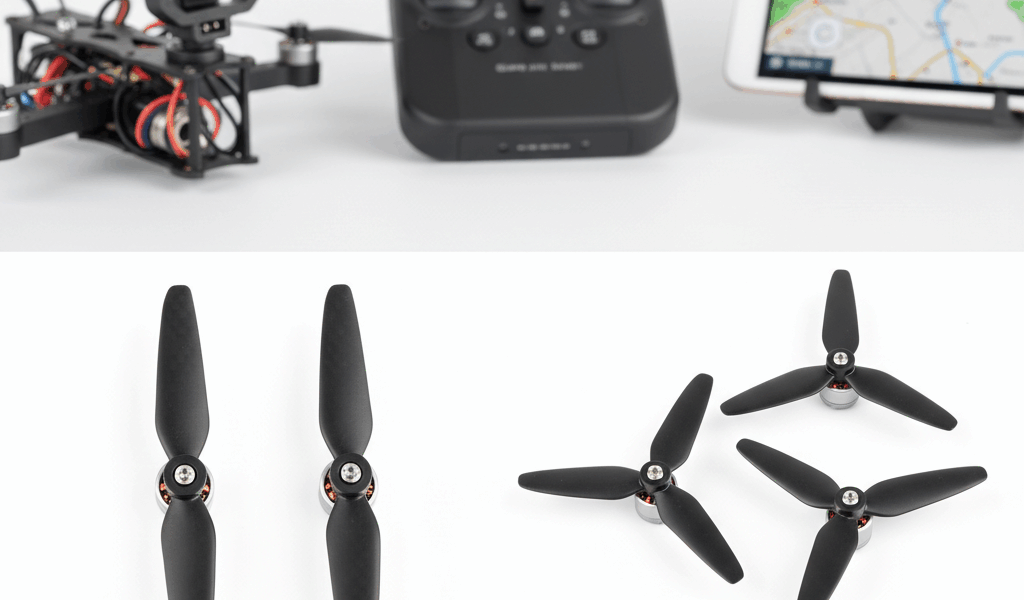
Propeller blade count affects nearly every aspect of mini drone performance. The choice between 2-blade and 3-blade configurations shapes efficiency, noise, thrust, and handling characteristics in ways every pilot should understand.
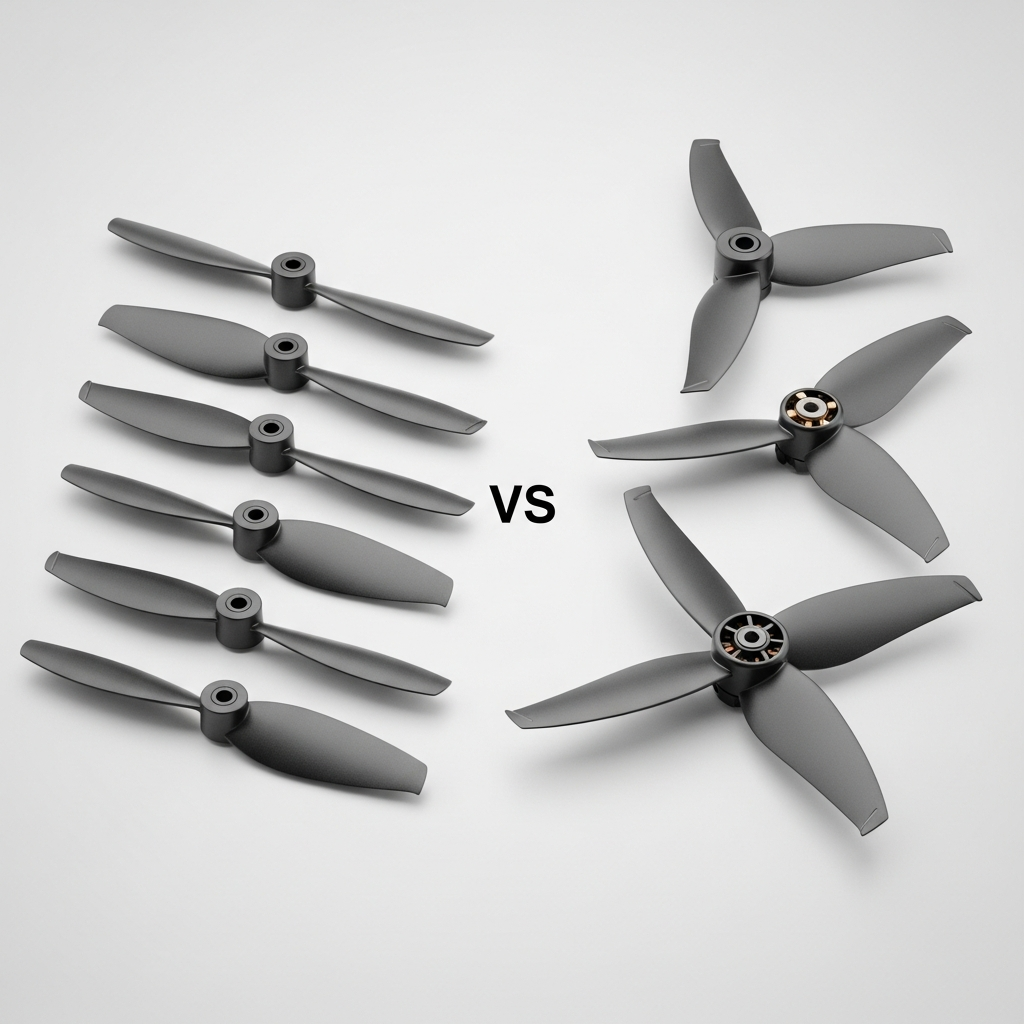
The Physics of Blade Count
More blades create more opportunities for air interaction during each rotation. A 3-blade propeller contacts air 50% more frequently per revolution than a 2-blade prop, generating thrust differently and producing distinct flight characteristics.
This increased blade area creates trade-offs rather than simple improvements. Each additional blade adds weight, drag, and complexity. Understanding these trade-offs helps match propeller choice to specific flying goals.
Efficiency: The 2-Blade Advantage
Two-blade propellers generally achieve higher aerodynamic efficiency than 3-blade alternatives of equivalent size. Fewer blades create less interference, allowing each blade to work in cleaner air.
The efficiency difference typically runs 5-15% in favor of 2-blade designs. On battery-limited mini drones, this translates directly to flight time. A quad flying 25 minutes on 3-blade props might achieve 27-28 minutes with 2-blade alternatives.
This efficiency advantage diminishes at higher thrust levels. When motors work hard—climbing, fighting wind, or carrying payloads—the efficiency gap narrows. Pilots flying gently benefit more from 2-blade efficiency than aggressive flyers pushing equipment limits.
Thrust: Where 3-Blade Props Excel
Three-blade propellers generate more static thrust than equivalent 2-blade options. The additional blade area accelerates more air mass, producing stronger pull at hover and low speeds.
This thrust advantage matters most during demanding maneuvers. Quick climbs, aggressive direction changes, and hover-heavy flying benefit from extra thrust available on demand. Pilots who push their drones hard often prefer 3-blade configurations.
For sub-250g builds with limited motor size, 3-blade props can partially compensate for modest power systems. The additional thrust helps smaller motors perform competitively against larger alternatives.
Noise Characteristics
Propeller noise extends beyond simple volume to include tonal quality and frequency distribution. Blade count significantly affects acoustic signature—the subjective annoyance level of drone sound.
Two-blade propellers typically produce lower frequency sounds with distinct pulses. These lower frequencies travel farther but often register as less irritating than higher-pitched alternatives. The periodic whomp-whomp of 2-blade props sounds relatively natural.
Three-blade propellers shift noise toward higher frequencies with more continuous sound character. While sometimes quieter in absolute decibels, the higher-pitched tone often seems more intrusive to listeners. Subjective noise perception varies between individuals.
DJI notably uses 3-blade configurations on Mini series drones, tuning prop design and motor timing to minimize perceived noise despite the blade count. Careful engineering can optimize either configuration for acceptable acoustics.
Handling and Response
Propeller characteristics affect how drones feel during flight. Blade count influences responsiveness, stability, and overall handling personality in noticeable ways.
Two-blade propellers create faster response to throttle inputs. Lower rotational inertia allows quicker acceleration and deceleration. Racing pilots often prefer 2-blade props for their immediate response to stick commands.
Three-blade propellers smooth out handling somewhat. Additional inertia filters rapid inputs, creating more predictable flight paths. Cinematic applications frequently favor this smoothness over raw responsiveness.
Prop wash handling differs between configurations. More blades create more disturbed air behind the drone. Descending through this turbulent wake affects 3-blade setups more noticeably than 2-blade alternatives in some flight conditions.
Durability Considerations
More blades means more opportunities for damage during crashes. Three-blade props present 50% more contact points with obstacles, increasing damage probability during tumbles and collisions.
Individual blade loading runs lower on 3-blade props—each blade works less hard for equivalent thrust. This reduced stress can improve individual blade longevity between crashes in normal operation.
Replacement costs favor neither configuration strongly. Both options remain inexpensive enough that cost shouldn’t drive blade count decisions for most pilots.
Weight Impact
Three-blade propellers weigh more than 2-blade equivalents—typically 10-25% additional mass. For sub-250g builds where every gram matters, this difference affects total weight budgets.
Four propellers means the weight difference multiplies by four. A 0.5-gram difference per prop becomes 2 grams total—potentially meaningful when building close to regulatory limits.
Higher rotor mass also increases rotational inertia, requiring more motor work to change speeds. This effect subtly reduces efficiency beyond the simple weight penalty.
Application Recommendations
Different flying styles align naturally with different blade counts. Matching propellers to intended use optimizes the overall flight experience.
For maximum flight time on camera drones, 2-blade props generally prove optimal. The efficiency advantage directly extends mission duration for pilots prioritizing time aloft.
For aggressive FPV freestyle, 3-blade props provide punch and responsiveness that aggressive pilots appreciate. The thrust headroom enables faster recovery from maneuvers and more confident proximity flying.
For indoor Tiny Whoops, 3-blade props help compensate for prop guards and cramped quarters. The extra thrust maintains controllability in ducted configurations where 2-blade options might struggle.
For quiet operation around people, neither configuration dominates—specific prop designs matter more than blade count. Test different options to find acceptable noise for your environment.
Pitch and Blade Count Interaction
Propeller pitch (blade angle) interacts with blade count in determining performance. Aggressive pitch amplifies thrust but reduces efficiency. Conservative pitch prioritizes efficiency over thrust.
High-pitch 2-blade props can approach 3-blade thrust levels while maintaining some efficiency advantage. Low-pitch 3-blade props can match 2-blade efficiency while providing smoother handling. Pitch selection enables tuning within each blade count category.
Testing Your Configuration
Ultimate propeller selection requires real-world testing. Specifications provide starting points, but flight experience reveals whether a configuration suits your specific needs and preferences.
When testing blade counts, fly the same routine with each option. Note flight time, handling feel, noise perception, and overall satisfaction. Multiple flights confirm whether initial impressions hold up across varied conditions.
Many pilots maintain both configurations, selecting props based on mission requirements. Competition flights might use 3-blade options for thrust while casual flights switch to 2-blade for extended duration.


Stay in the loop
Get the latest light drones updates delivered to your inbox.