Drone The Physics of Drone Flight Ti guidance has gotten complicated with all the outdated regulations and conflicting advice flying around. Here’s what you actually need to know.
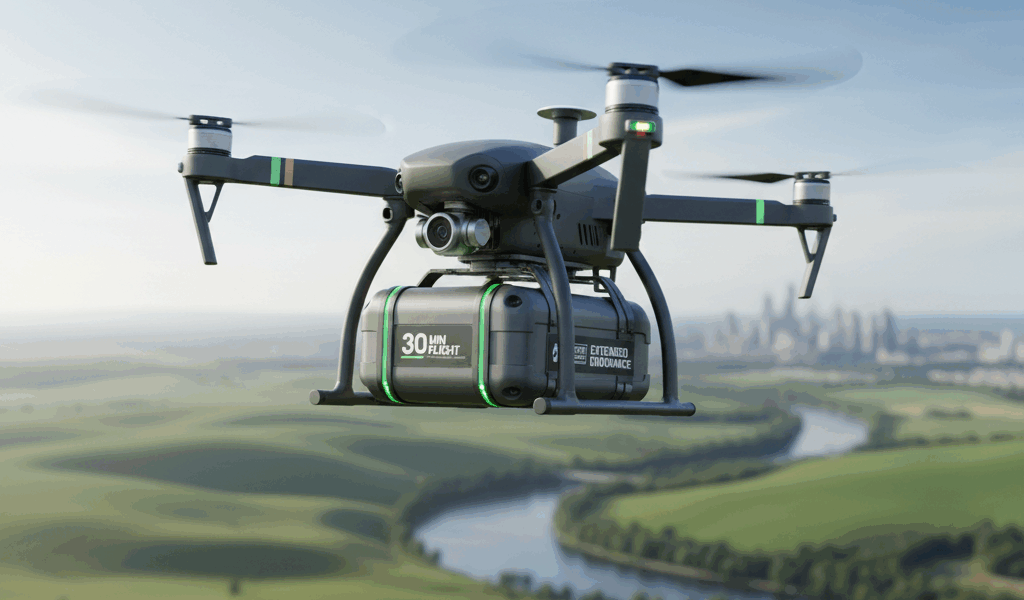
Thirty minutes of flight time from a sub-250g drone once seemed impossible. Battery technology advances and power efficiency improvements now make extended flights routine, transforming how pilots approach aerial missions.
The Physics of Drone Flight Time
Flight duration depends on a simple relationship: battery energy capacity versus power consumption. Extending flight time requires either storing more energy or consuming less power—ideally both simultaneously.
Weight plays a critical role in this equation. Heavier drones require more lift, which demands more power from motors. Every gram added to battery capacity must generate enough additional flight time to justify the weight penalty of carrying it. This trade-off creates an optimal battery size for each drone design.
Battery Energy Density Improvements
Lithium polymer batteries have improved steadily over decades of development. Modern cells pack more watt-hours into each gram of battery weight than previous generations, directly extending flight time without changing aircraft weight.
Current high-quality drone batteries achieve energy densities around 200-250 Wh/kg at the cell level. Pack-level densities run lower due to protection circuitry, structural cases, and connector weight. Premium cells from manufacturers like Sony, Samsung, and LG consistently outperform budget alternatives.
LiHV (Lithium High Voltage) chemistry pushes energy density further by charging cells to 4.35V instead of the standard 4.2V. This modification adds 5-10% capacity at the cost of reduced cycle life—a worthwhile trade for many pilots prioritizing flight time.
Intelligent Battery Management
Smart batteries incorporate management systems that optimize charging, monitor cell health, and protect against dangerous conditions. These systems enable deeper safe discharge and more complete charging than basic battery packs allow.
Cell balancing during charging ensures all cells within a pack reach identical voltages. Imbalanced cells waste capacity—the lowest cell determines usable pack capacity. Quality battery management extends effective capacity throughout battery lifespan.
Temperature monitoring adjusts charge and discharge rates to prevent damage. Cold batteries charge slowly to avoid lithium plating. Hot batteries reduce output to prevent thermal runaway. This active management maintains both safety and longevity.
Power Consumption Optimization
Reducing power consumption extends flight time as effectively as increasing battery capacity. Drone manufacturers attack consumption through motor efficiency, aerodynamic refinement, and intelligent power management.
Modern brushless motors achieve efficiencies exceeding 85%—converting most electrical input into useful thrust rather than waste heat. Optimal motor sizing matches propeller loads to motor characteristics, maintaining efficiency across typical flight conditions.
Propeller design affects both thrust efficiency and power consumption. Multi-blade propellers and optimized pitch profiles extract more lift per watt than simple designs. Premium drones use propellers specifically engineered for their motor and flight envelope combinations.
Aerodynamic Efficiency Gains
Drag forces increase exponentially with speed. Streamlined airframes reduce drag, requiring less power to maintain equivalent speeds. Even small aerodynamic improvements accumulate into meaningful flight time extensions.
Mini drone designs increasingly feature enclosed arms, rounded body shapes, and minimized protrusions. These refinements reduce parasitic drag that wastes battery capacity during forward flight. Hover efficiency remains relatively unaffected by aerodynamics.
Wind resistance affects flight time dramatically. Flying in calm conditions extends duration significantly compared to fighting gusty winds. Smart pilots schedule demanding shoots during calm morning or evening windows when possible.
Flight Mode Impact on Duration
How you fly affects battery consumption as much as drone design. Understanding power consumption patterns helps maximize available flight time during each mission.
Hovering consumes less power than forward flight at typical speeds. However, slow forward movement often proves more efficient than pure hover—the aircraft benefits from transitional lift that reduces motor workload. Walking pace flight frequently optimizes consumption.
Aggressive maneuvers spike power consumption dramatically. Rapid climbs, sharp turns, and sport mode acceleration drain batteries far faster than gentle flying. When flight time matters, smooth piloting extends duration meaningfully.
Altitude affects consumption through air density changes. Higher altitudes feature thinner air requiring more rotor pitch and motor power for equivalent lift. Dense low-altitude air provides more efficient flying conditions for extended missions.
Temperature Effects on Capacity
Lithium batteries perform best within moderate temperature ranges. Cold conditions reduce available capacity substantially—a battery rated for 30 minutes in warm weather might provide only 20 minutes on cold mornings.
Pre-warming batteries before cold-weather flights helps recover capacity. Keep batteries close to your body or in insulated cases until ready to fly. Some pilots use hand warmers in battery pouches during winter operations.
Hot conditions reduce capacity less dramatically but accelerate battery degradation. High-temperature flights shorten overall battery lifespan even if individual flight times remain acceptable.
Realistic Flight Time Expectations
Manufacturer flight time specifications assume optimal conditions: no wind, warm temperatures, no payload, gentle flying, and new batteries. Real-world flights rarely match these idealized parameters.
Plan for 70-80% of advertised flight times under typical conditions. A drone rated for 34 minutes realistically delivers 24-27 minutes of practical flying including takeoff, positioning, and landing reserves. This planning prevents emergency landings from depleted batteries.
Battery age reduces capacity progressively. After 50-100 cycles, expect 10-20% capacity reduction from new-battery baselines. Monitor per-flight times to identify batteries approaching replacement thresholds.
Extending Flight Time Practically
Beyond battery and drone selection, operational practices influence achievable flight times:
- Fully charge batteries before each flight—partial charges waste capacity
- Fly during calm conditions when possible
- Use normal or cine modes rather than sport mode for most work
- Avoid unnecessary hovering—reposition efficiently between shots
- Land with 20-25% battery remaining for safety and longevity
- Store batteries at 40-60% charge for extended periods
- Replace aging batteries before capacity loss impacts missions
Future Battery Technology
Solid-state batteries promise significant energy density improvements over current lithium polymer technology. Commercial availability remains years away, but eventual adoption could dramatically extend mini drone flight times.
Silicon anode batteries offer nearer-term improvements, potentially increasing energy density 20-40% over current cells. Some manufacturers already incorporate silicon in anode blends with progressive capacity benefits.
Regardless of chemistry advances, the fundamental trade-offs between weight, capacity, and flight time persist. Future drones will benefit from better batteries, but optimal design will always balance these competing factors carefully.


Stay in the loop
Get the latest light drones updates delivered to your inbox.