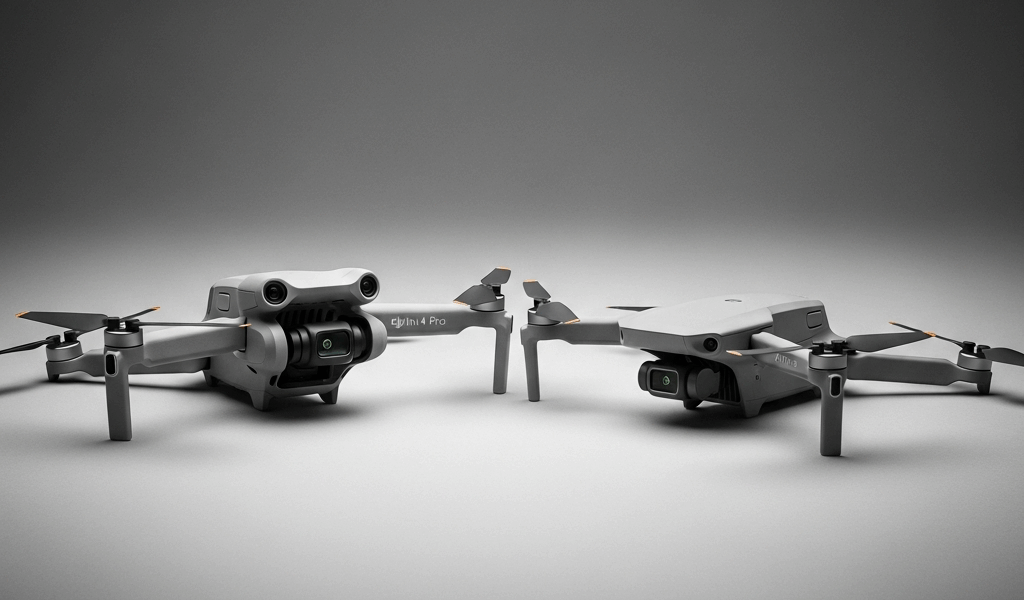
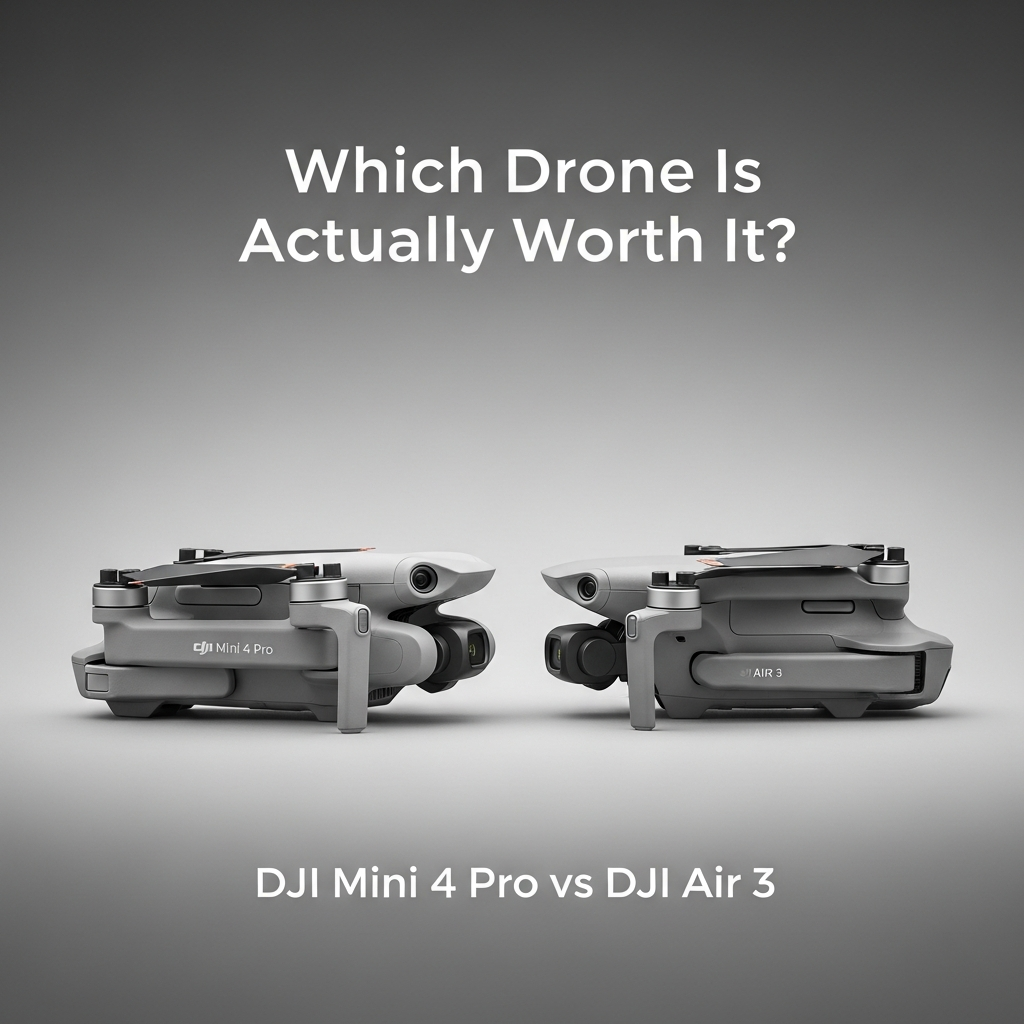
DJI Mini 4 Pro vs DJI Air 3 — Which Drone Is Actually Worth It
Drone comparisons have gotten complicated with all the spec-sheet noise flying around. Every forum thread, every YouTube comment section, every subreddit dedicated to DJI gear has been arguing about the Mini 4 Pro versus the Air 3 since both launched — and honestly, most of those comparisons just reformat the spec sheets into paragraph form and call it a day. As someone who flew both drones extensively — two weeks through Portugal with the Mini 4 Pro, then real estate and landscape shoots across Colorado with the Air 3 — I learned everything there is to know about what separates these two machines. They are not the same drone with minor differences. Not even close.
This article includes affiliate links. We may earn a commission at no extra cost to you.
Two DJI Drones, Very Different Priorities
Before any camera specs or flight data, the core tradeoff needs naming — because it shapes every single decision after it.
The DJI Mini 4 Pro weighs 249 grams. That number isn’t a coincidence. It’s an engineering mandate. DJI built this thing to land just under the FAA’s 249g registration threshold, which means casual flyers in the US don’t need to register it for recreational use. It folds down small — fits in a jacket pocket with the right case — and runs $759 for the standard combo as of late 2024. A drone built around freedom of movement and minimal friction.
The DJI Air 3 weighs 720 grams, costs $1,099 for the standard combo, and answers a completely different question: how much image quality and operational capability can we pack into something still reasonably portable? Dual-camera system — wide-angle plus a 3x medium telephoto — larger footprint, and the overall feel of a working tool rather than a travel companion.
Neither of these is wrong. They’re just answers to different questions.
Camera Quality Head-to-Head
But what is the actual camera gap here? In essence, it’s smaller than you’d expect on paper — but much more than that once you’re in the field. Both drones use a 1/1.3-inch CMOS sensor on their main wide-angle cameras. Same sensor size. On paper, similar output. In practice, I learned that lesson the hard way the first time I edited footage from both side by side and saw results that were noticeably, sometimes frustratingly different.
Video and Photo Output in the Field
The Mini 4 Pro shoots up to 4K at 100fps and supports D-Log M color profile — genuinely impressive for something that weighs less than a can of soup. In good light — golden hour, midday overcast — the footage looks excellent. I’ve delivered client work shot on the Mini 4 Pro. No complaints. Sharpness holds up, dynamic range handles well-lit scenes well, and D-Log M grades cleanly.
Low light, though? That’s where things fall apart fast.
The Air 3’s main sensor — same size on paper — performs noticeably better in low-light conditions. Partly the lens design, partly aperture characteristics, partly what seems like a more refined processing pipeline. Shooting at dusk outside Estes Park, Colorado, the Air 3 footage had less noise and better shadow detail than comparable Mini 4 Pro shots taken minutes apart under the same sky. Not a subtle difference. Visible at 1080p on a laptop screen.
The Dual Camera Advantage
Probably should have opened with this section, honestly — because the Air 3’s second lens changes how you shoot more than almost any other feature on this list. The 70mm equivalent 3x medium telephoto opens up compositional options that simply don’t exist on the Mini 4 Pro. Compressing a mountain range. Isolating a subject against a background. Getting tight on architecture without repositioning the drone.
I started thinking differently with the Air 3 — two focal lengths on a single flight, the way you’d think with a camera bag full of glass. The Mini 4 Pro is single-focal-length flying. That’s a real creative constraint, depending on the work.
Both drones shoot 4K/60fps. Both support 10-bit color. Both have obstacle avoidance. The camera gap is real — it just matters more for some shooting contexts than others.
Flight Performance and Range
Caught by an unexpected wind gust on a ridge outside Sintra, Portugal, I watched my Mini 4 Pro drift off my intended flight path before I could correct. Drone was fine — obstacle avoidance kicked in — but it was a genuine “oh, right, this weighs 249 grams” moment. Don’t make my mistake of forgetting that weight matters in the air until a coastal wind reminds you.
The Mini 4 Pro is rated for wind resistance up to 10.7 m/s — roughly 24 mph, DJI’s Level 5 winds. The Air 3 handles up to 12 m/s, around 27 mph. Those numbers sound close on a spec sheet. They don’t feel close when you’re flying near terrain with unpredictable gusts coming off ridgelines.
Battery Life
The Mini 4 Pro claims up to 34 minutes per battery. The Air 3 claims up to 46 minutes. Real-world flying — takeoff, repositioning, actual shooting, hovering while you review a composition — I typically pull 28-30 minutes from the Mini 4 Pro and 38-42 minutes from the Air 3 before bringing them home. That extra time matters on location. Fewer battery swaps. More flexibility. More chances to wait out a cloud formation or catch a light shift you’d otherwise miss.
Transmission Range
Both drones run DJI’s O4 video transmission system — maximum range up to 20km under ideal conditions. Open terrain, both performed comparably in my testing. Urban environments with heavier RF interference? The Air 3 held signal slightly more reliably in my experience. Apparently the interference handling is a bit more robust, though I’d want more controlled testing before calling that definitive.
The RC2 controller — bright screen, intuitive layout — is excellent on both drones. No complaints either way.
The 249g Rule — Why It Matters More Than You Think
This is the section that changed my thinking. Understanding the full scope of what that weight limit actually does for you shifts the whole comparison.
In the United States, the FAA requires drones at 250 grams or more to be registered for recreational use — $5 fee, valid for 3 years. Commercial operators under Part 107 register regardless of weight. But the operational differences go well beyond paperwork.
The Real-World Regulatory Advantage
A lot of countries outside the US tie their drone regulations to that same 250g line — the dividing point between “open” category operations with minimal restrictions and more heavily regulated categories. Flying through France, Portugal, and parts of Canada with the Mini 4 Pro, I was operating in the open category with essentially zero permit requirements for recreational flying. That same trip with the Air 3 would’ve required advance notification or registration in several of those locations.
That’s what makes the 249g threshold so endearing to us travel shooters. Permit processes can take days. Weeks, sometimes. Some locations require third-party liability insurance for heavier drones. The Mini 4 Pro removes whole categories of friction before you even leave your hotel room.
Travel with Drones — Practically Speaking
The Mini 4 Pro with the Fly More combo — three batteries, the RC2 controller, a handful of ND filters — fits inside a DJI shoulder bag that slides under the seat on a flight. No checked luggage, no gear anxiety, no TSA conversations about lithium battery quantities. I’ve done this repeatedly. It works exactly as advertised.
Traveling with the Air 3 means a dedicated hard case or a larger camera bag. Doable — people do it every day — but it adds friction, weight, and attention at security checkpoints. If you want to grab a drone the way you’d grab a mirrorless camera and just go, the Mini 4 Pro is genuinely in a different category.
Insurance Considerations
DJI Care Refresh prices differently across weight classes. The Mini 4 Pro’s annual plan runs $79 as of 2024. The Air 3’s runs $149. Not a dealbreaker on its own — but part of an honest total cost of ownership calculation that most comparison articles skip entirely.
The Verdict — Buy Based on How You Actually Fly
Here’s the clear answer, broken down by use case instead of vague “it depends” hedging.
Buy the DJI Mini 4 Pro If
- You travel frequently and want a drone that fits in your carry-on without elaborate planning
- You fly recreationally and want to skip FAA registration requirements
- You shoot primarily in decent lighting — travel content, outdoor activities, casual landscape work
- Budget matters and $759 is meaningfully different from $1,099
- You fly internationally and want to minimize regulatory paperwork across different countries
- You want a drone you’ll actually bring everywhere — not one you leave at home because it’s too much gear
Buy the DJI Air 3 If
- You shoot professionally or semi-professionally and image quality is a deliverable, not just a preference
- You need that second focal length — the 3x telephoto opens creative options the Mini 4 Pro can’t touch
- You fly regularly in variable or challenging conditions where wind resistance and battery life affect the work
- You do real estate, events, commercial landscape work, or any context where a client is judging footage critically
- Low-light performance is a regular part of your shooting requirements
The Overall Winner
For most people reading this? The Mini 4 Pro. Most people who buy drones don’t fly them as often as they imagine they will — and the drone that actually gets used is the one that’s easy to bring along. The Mini 4 Pro removes every possible excuse not to grab it. Fits in a bag, clears regulations in most places, produces footage that genuinely looks great in the conditions most people shoot in. The Air 3 wins most objective technical categories. But a better drone sitting in a case at home loses to a good-enough drone in your bag every single time.
That said — if you already know you’re a committed pilot, you shoot for clients, and you’ve been flying long enough to fill up hard drives with footage — buy the Air 3 without second-guessing it. The dual camera system alone justifies the price gap for working shooters, and the performance ceiling will matter to you in ways it simply won’t to someone flying twice a month on vacation.
Both are excellent drones. Neither is a mistake. Just buy the one that matches how you actually fly — not the pilot you’re planning to become someday.

Stay in the loop
Get the latest light drones updates delivered to your inbox.